
The Pet Travel Glossary: 70+ Terms Every Pet Parent Should Know
 By Georgiana Strait, Marketing Manager
Moving a pet internationally involves a language most people only learn once — usually while they're stressed, on a deadline, and staring at a government website written for veterinarians. This is a comprehensive resource to help you speak it fluently before you need to.
Every term below gets a plain-English definition and a short note on why it actually matters to your move.
Worth bookmarking. Rules change country by country and year by year — a health certificate window that was valid last year might not be this year, and airlines revise their pet policies more often than most owners realize. We keep this page current, which makes it more useful to come back to than to copy into a notes app.
How to read this glossary. Terms are grouped into 8 sections so you can learn the process in order. If you're just starting to research a move, start with Core Concepts. If you're already deep into paperwork, jump straight to Documents & Regulatory Paperwork.
1. Core Concepts
Pet Relocation
The process of moving a pet from one country (or sometimes one state) to another, covering everything from paperwork to transport to arrival. It's a subset of pet travel, but the term specifically implies a household move rather than a vacation. Starwood's international pet transport services page covers what a full relocation actually involves.
Pet Travel
The broader umbrella covering any trip a pet takes with its owner, whether that's a weekend drive or an international relocation. Most of the regulatory complexity in this glossary only kicks in once you cross a border.
Pet Shipping
An older, less precise term for pet relocation that's fallen out of favor because it makes the process sound like sending a package. Reputable companies avoid it in their own marketing, but it still shows up constantly in search queries, which is worth knowing if you're the one writing the content that needs to be found.
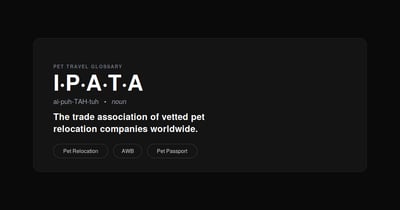
IPATA (International Pet and Animal Transportation Association)
A trade association of vetted pet shipping companies worldwide, each of which agrees to a code of ethics and completes ongoing training. Visit ipata.org to see the standards members agree to. IPATA membership is the closest thing this industry has to a credential, and it's the first thing a cautious pet owner should check before hiring anyone — see Starwood's own guide on how to choose a pet shipping company.
Pet Relocation Specialist / Coordinator
The person at a relocation company who manages your move end to end — paperwork, bookings, crate specs, and the dozens of small deadlines in between. A good coordinator is the difference between a smooth move and a scramble at the airport. Starwood's how it works page walks through what that coordination actually looks like.
Door-to-Door Service
A relocation package where the company handles pickup at the pet's current home and delivery to the new one, including all transport and paperwork in between. It costs more than a partial service, and it's what most owners actually want once they see how many moving parts are involved. See Starwood's full-service transport options.
Door-to-Airport Service
A relocation package that ends at the departure airport, leaving the owner (or someone at the destination) to handle arrival, customs, and onward transport. Cheaper, and only advisable if someone capable is meeting the pet at the other end.
Live Animal Transport
The formal classification airlines and regulators use for any shipment involving a living animal, as opposed to standard cargo. It triggers a separate set of handling rules, temperature protections, and paperwork requirements the moment it applies — governed globally by IATA's Live Animals Regulations.
Corporate Pet Relocation
Pet moves arranged or subsidized as part of an employee's job relocation, usually coordinated between the relocation company and the employer's HR or mobility team rather than billed directly to the pet owner. See Starwood's corporate pet relocation program.
Military PCS Pet Move
A pet relocation tied to a service member's Permanent Change of Station (PCS) orders, which often comes with its own timeline pressures, base-specific requirements, and sometimes partial reimbursement. See Starwood's military relocation services.
2. Documents & Regulatory Paperwork
Health Certificate
A veterinarian-issued document confirming a pet is healthy enough to travel and meets the destination country's entry requirements. Nearly every document below exists to support or verify this one. The USDA's APHIS Pet Travel portal is the starting point for U.S. pet owners.
AHC (Animal Health Certificate)
The specific term used for the health certificate required for pets entering the European Union (and used more broadly in UK and Commonwealth pet travel contexts). It must typically be issued and endorsed within a narrow window — often 10 days — before travel, which is the single most common reason a move gets delayed. The UK government's guidance on bringing a pet into Great Britain explains the AHC requirement in detail.
USDA Endorsement
The step where a health certificate issued by a vet in the U.S. gets countersigned by a USDA-accredited official (through APHIS) to make it valid for international entry. Skipping this step is one of the fastest ways to have a pet denied entry at the border, no matter how thorough the rest of the paperwork is.
APHIS (Animal and Plant Health Inspection Service)
The USDA division responsible for endorsing health certificates and enforcing animal movement regulations in the United States, via its Pet Travel program. It's the U.S. government's half of nearly every outbound pet relocation.
USDA-Accredited Veterinarian
A vet specifically certified to complete and sign health documentation for USDA endorsement. Not every vet holds this accreditation, so confirming it early avoids finding out too late that your pet's usual vet can't sign the paperwork you need.
Import Permit
A destination country's advance authorization to bring a pet across its border, required by some countries (including Australia and several others with strict biosecurity rules) before the pet ever leaves home. Missing one can mean the pet isn't legally allowed to land, regardless of every other document being in order. Canada's CFIA import tool is a good example of how a destination country structures this requirement.
Export Permit
The origin country's equivalent authorization, required in some jurisdictions to legally send an animal out. Less common than import permits, but non-negotiable where it applies.
Rabies Titer Test (FAVN)
A blood test measuring a pet's rabies antibody levels, required by rabies-free and rabies-controlled countries as proof of effective vaccination. It must usually be drawn a set number of months before travel and processed at an approved lab, which makes it one of the earliest deadlines in any relocation timeline. Starwood's pet travel FAQs cover how and when to schedule one.
ISO Microchip
A 15-digit microchip meeting the ISO 11784/11785 international standard, required by most countries as the primary way of matching a pet to its paperwork. A non-ISO chip (common in older U.S.-implanted chips) can require a compatible scanner brought along for travel, or a second ISO chip altogether. You can check how a chip is registered using AAHA's universal microchip lookup tool.
Pet Passport
A standardized travel document, most familiar from the EU system, that consolidates a pet's vaccination history, microchip number, and health records into one booklet for repeat cross-border travel. Not every country issues or recognizes one, so it's a convenience rather than a universal requirement — the UK's pet travel document guidance explains which document applies where.
CITES Permit
A permit required under the Convention on International Trade in Endangered Species for animals (or animal products) on its protected list. Rarely relevant to dogs and cats, but essential for exotic pets, and easy to overlook if you assume it only applies to wildlife traffickers.
Non-Commercial Movement
The regulatory classification for a pet traveling with its owner for personal reasons rather than sale or breeding. It usually comes with simpler paperwork than commercial movement, so getting this classification right on the forms matters.
Health Certificate Validity Window
The specific number of days a health certificate remains valid for travel, set by the destination country and often as short as 2–10 days. It's the deadline every other piece of the relocation timeline gets built backward from — see Starwood's how it works page for how this fits into a full move.
3. Airlines & Air Transport
AWB (Air Waybill)
The contract and tracking document issued by an airline for cargo shipments, including pets traveling as manifest cargo. It's the pet-travel equivalent of a boarding pass and a bill of lading combined, and you'll need its number to track your pet's flight status. See Starwood's pet air transportation services for how this fits into a booking.
IATA Live Animals Regulations (LAR)
The International Air Transport Association's rulebook covering crate specifications, labeling, and handling standards for live animals in air transport. Nearly every airline and many countries defer to the IATA LAR as the baseline standard, which is why an "IATA-compliant crate" is the phrase you'll hear over and over.
Manifest Cargo
The classification for a pet traveling in the cargo hold as a formally booked, tracked shipment — distinct from checked baggage. Most large or restricted-breed pets, and most international relocations, travel this way rather than as excess baggage. See Starwood's air transportation services.
Excess Baggage
A pet travel option on some airlines where a smaller pet flies in the cargo hold as an extension of the owner's own baggage allowance, on the same flight. It's usually cheaper and simpler than manifest cargo, but far fewer airlines and routes still offer it.
In-Cabin Travel
Pet travel where a small enough pet rides in an airline-approved carrier under the seat in front of the owner. Weight limits, carrier dimensions, and route eligibility vary enormously by airline, and international routes offer it far less often than domestic ones.
Cargo Hold (Pressurized & Temperature-Controlled)
The section of the aircraft where pets in manifest cargo or excess baggage travel — climate-controlled and pressurized like the passenger cabin, contrary to a common misconception. Starwood's blog goes into detail on where pets actually fly on a plane.
Temperature Embargo
An airline-imposed restriction blocking live animal transport when ground temperatures at any airport on the route are forecast above or below a safe threshold. It's set at the departure, layover, and arrival airports alike, which is why a pet can be grounded by weather in a city it's only passing through. Starwood covers this in Will My Pet Be Safe on an Airplane?
Brachycephalic Breed Restriction
An airline policy limiting or banning air travel for short-nosed breeds (bulldogs, pugs, Persian cats, and similar) due to their elevated risk of respiratory distress in flight. Restrictions vary by airline, and some ban these breeds outright regardless of health documentation — more in Starwood's pet air travel safety guide.
Connecting Flight / Layover
Any itinerary requiring a pet to be transferred between flights, which introduces additional handling, additional temperature-embargo exposure, and additional risk. Relocation specialists work hard to book direct routes for exactly this reason.
Live Animal Desk
The airline department specifically responsible for coordinating live animal shipments, separate from standard cargo or passenger services. It's the point of contact for booking, tracking, and resolving issues with a pet's flight.
Groundhandler
The airport-based company contracted to physically load, unload, and hold animals in transit between flights or before pickup. Their care standards can vary by airport, which is part of why route selection matters as much as airline selection.
4. Crates & Travel Equipment
IATA-Approved Crate
A travel crate meeting IATA's Live Animals Regulations for size, ventilation, and structural strength — required for any pet traveling as manifest cargo or excess baggage. Airlines and customs officials can and do reject non-compliant crates at the gate, so this isn't a suggestion. Starwood's travel kennel calculator helps you check yours against your pet's measurements.
Crate Sizing
The requirement that a travel crate allow a pet to stand, turn around, and lie down naturally, measured against the pet's exact height and length rather than its weight class alone. Undersized crates are one of the most common reasons a pet gets bumped from a flight — run your numbers through Starwood's travel kennel calculator.
Crate Acclimation
The process of gradually getting a pet comfortable spending time in its travel crate well before the trip, rather than introducing it for the first time on travel day. It reduces stress for the animal and improves the odds of a calm flight — see Starwood's take on better alternatives to sedating your pet for travel.
Live Animal Sticker
The mandatory exterior labeling on a travel crate identifying it as containing a live animal, along with handling instructions and orientation arrows. Airlines require it to be visible and correctly placed before they'll accept the crate.
Crate Water & Food Attachments
Spill-resistant, externally accessible dishes attached to the inside of the crate door so ground staff can offer water without opening the crate mid-transit. It's a small detail that regulators actually check.
5. Destination-Specific Rules
Quarantine
A mandatory holding period for an incoming pet, historically the default in rabies-free countries like Australia and still required in some jurisdictions today. Many countries have replaced blanket quarantine with the titer-test-and-waiting-period pathway below, but it hasn't disappeared everywhere.
Quarantine-Free Pathway
A set of pre-arrival requirements (rabies titer test, waiting period, health documentation) that lets a pet skip quarantine on arrival if every condition is met exactly. Missing even one requirement can mean falling back into the quarantine track you were trying to avoid — see Starwood's Australia destination guide.
DEFRA (UK)
The UK's Department for Environment, Food and Rural Affairs, which sets pet import rules for entry into Great Britain — laid out in the government's guidance on bringing a pet to Great Britain. Its requirements diverge from the EU's in specific ways since Brexit, which trips up owners assuming the same paperwork works for both. See also Starwood's United Kingdom destination guide.
CFIA (Canada)
The Canadian Food Inspection Agency, responsible for Canada's pet and animal import rules. Requirements are comparatively lighter for dogs and cats from many countries, which surprises owners used to stricter regimes elsewhere.
Rabies-Free / Rabies-Controlled Country
A classification used by many destinations to determine how strict their entry requirements are — countries with no or well-controlled rabies (Australia, New Zealand, the UK, Japan, and others) impose the tightest rules. Where your pet is coming from matters just as much as where it's going.
Biosecurity
The broader category of rules protecting a country's animal and plant health from imported disease, pests, or parasites — pet import rules are one piece of a much larger system, like the one CFIA enforces at the Canadian border. It's why some countries scrutinize things as specific as the wood in a shipping crate.
Port of Entry
The specific airport or border crossing authorized to process incoming pets, which is not automatically every international airport in a country. Booking a flight into the wrong airport can mean a pet simply can't be legally admitted there.
Customs Clearance
The final inspection and paperwork review a pet goes through on arrival before being released to its owner or agent. It's the last checkpoint where a documentation gap can still cause a delay — see Starwood's international pet transport services for how this is managed door-to-door.
6. Industry & Who's Who
Pet Relocation Company
A business, ideally IPATA-affiliated, that manages the logistics of moving a pet internationally on behalf of owners. Services range from full door-to-door management to single-service bookings — see why Starwood for how one relocation company positions itself.
IATA-Certified Cargo Agent
An agent authorized to book and process animal shipments directly with airlines under IATA standards. Working with one (directly or through a relocation company) is often the only way to access certain routes and cargo booking systems at all.
Freight Forwarder
A logistics company that arranges cargo transport on behalf of a shipper — in pet travel, often the entity actually booking the AWB and coordinating with the airline behind the scenes. Some pet relocation companies act as their own freight forwarder; others contract one.
Customs Broker
A licensed professional who handles the customs clearance process on the owner's behalf, particularly useful for destinations with more complex import bureaucracy. Not required everywhere, but often worth it where it is.
Import Agent
A representative at the destination country who receives the pet, manages local customs and clearance steps, and hands the pet off to its owner or onward transport. On longer relocations, this is often a different company than the one that handled departure.
Destination Boarding / Layover Kennel
A licensed facility used to house a pet overnight or longer during an unavoidable layover, quarantine period, or gap before an owner is ready for pickup. Facility standards vary widely, which is why relocation companies vet them ahead of time rather than booking whatever's closest.
7. Timing & Logistics
Relocation Timeline
The full sequence of deadlines — titer test, health certificate window, permits, booking — mapped backward from a target travel date. Because so many of these steps have hard windows (some measured in months, some in days), the timeline usually needs to start well before the move itself feels imminent. Starwood's how it works page lays out a typical sequence.
Peak Season / Embargo Season
The period (typically summer) when temperature embargoes are most likely to ground flights and airline cargo capacity is tightest due to demand. Booking early and building in flexibility matters most during exactly this window.
Acclimation Certificate
A veterinarian's written statement that a pet can tolerate temperatures outside an airline's standard safe range, sometimes allowing travel during a temperature embargo that would otherwise apply. Not all airlines accept them, and the ones that do apply strict conditions.
Cold Weather Waiver
The cold-weather equivalent of an acclimation certificate, used in the same way to request an exception to a low-temperature embargo. Same caveat: acceptance is airline-specific and never guaranteed.
Booking Window
The airline-specific advance notice required to book a pet's cargo space, which is often longer than a typical passenger booking window and can shrink drastically during peak season. Waiting too long to book is one of the most avoidable causes of a delayed move.
8. Costs & Booking
All-Inclusive Quote
A relocation price that bundles crate, health paperwork coordination, flight booking, and door-to-door service into a single number. Easier to budget against, and worth confirming exactly what's excluded (destination customs fees are a common gap). See Starwood's breakdown of international pet relocation costs.
À La Carte Pricing
A pricing structure where each service — crate, paperwork, flight booking, ground transport — is quoted and purchased separately. Can be cheaper for owners handling part of the process themselves, but requires more coordination on the owner's end.
Peak Season Surcharge
An added cost some airlines and relocation companies apply during high-demand travel windows, reflecting tighter cargo capacity and higher operational costs. It's one more reason early booking tends to pay for itself — see Starwood's cost guide for how this factors into a quote.
Destination Fees
Costs incurred on arrival — customs clearance, import agent handling, or layover boarding — that aren't always included in an origin-side quote. Asking specifically what happens after landing is the easiest way to avoid a surprise invoice. Starwood's get a quote process itemizes this up front.
A–Z Index
A
B
C
- Cargo Hold
- CFIA (Canada)
- CITES Permit
- Cold Weather Waiver
- Connecting Flight / Layover
- Corporate Pet Relocation
- Crate Acclimation
- Crate Sizing
- Crate Water & Food Attachments
- Customs Broker
- Customs Clearance
D
- DEFRA (UK)
- Destination Boarding / Layover Kennel
- Destination Fees
- Door-to-Airport Service
- Door-to-Door Service
E
F
G
H
I
- IATA-Approved Crate
- IATA-Certified Cargo Agent
- IATA Live Animals Regulations (LAR)
- Import Agent
- Import Permit
- In-Cabin Travel
- IPATA
- ISO Microchip
L
M
N
P
- Peak Season / Embargo Season
- Peak Season Surcharge
- Pet Passport
- Pet Relocation
- Pet Relocation Company
- Pet Relocation Specialist / Coordinator
- Pet Shipping
- Pet Travel
- Port of Entry
Q
R
T
U
Have a term you keep running into that isn't here? Starwood Pet Travel has been navigating international pet relocation for 40+ years, and we're always expanding this glossary as regulations change. Ready to start your own move? Get a quote or contact us.
Explore with AI
Have questions about this article? Ask an AI assistant directly.
 Open in ChatGPT →
 Open in Claude →
Make this guide about your pet.
Every pet's move is a little different. Pick an AI assistant, hit send, and chat through your pet's breed, your route, and your timeline. You'll land with a checklist made for your move.
AI can get details wrong, and pet import rules change often, so double-check before you travel.
FlightDestinationStatus
SW 101
Ask ChatGPT
Boarding
SW 102
Ask Claude
Boarding
SW 103
Ask Perplexity
Boarding
SW 104
Ask Gemini
Boarding
Copies the message to your clipboard, then opens Gemini so you can paste it
See the message we'll send

About the Author
Georgiana Strait, Marketing Manager
Georgiana Strait is a marketing manager at Starwood Pet Travel, where she leads content strategy, SEO, paid media, and marketing automation across the company's international pet relocation services. A performance-driven digital marketing strategist with a background in customer acquisition and data analytics, Georgiana brings a sharp, iterative approach to building out Starwood's marketing infrastructure, from AI search visibility to lifecycle campaigns. She's also a U.S. Army veteran. Outside of work, Georgie is an avid traveler who has hiked to Everest Base Camp. She lives with her cat, Lavender.
Talk to our experts
Need help or have questions? Our team is ready to help!

Get a quote →
Subscribe for Monthly Updates
Subscribe for expert pet travel tips, updates, and relocation guides—delivered to your inbox.