

International Pet Shipping
Pet Kennels
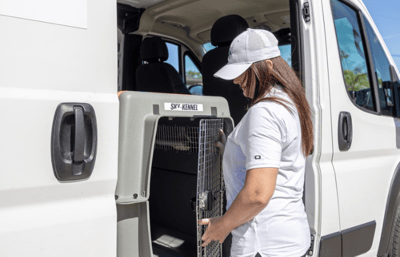
Travel Kennel
SHORT ANSWER
Yes, every pet flying internationally in the cargo hold needs its own airline-compliant travel kennel, but you don't have to source it alone. Starwood Pet Travel offers packages that include a kennel and accessories, and if you'd rather buy one yourself, your Pet Travel Coordinator will tell you exactly which brand, model, and size to purchase. Whichever route you choose, the kennel must meet International Air Transport Association (IATA) container standards and the specific construction rules of the airline flying your pet, or your pet can be refused at check-in.
Can Starwood Provide the Travel Kennel for My Pet?
This was one of the questions we took on during a recent Pet Travel Insider session, when a viewer asked us directly: do you provide the kennels, or do I need to buy them?
The answer is that you have both options. Ryan Bole, Director of Pet Travel Coordinators at Starwood Pet Travel, explained it this way: "We have packages that you can add on a kennel, and if you don't want to do it through us, we will give you the kennel we would recommend. Airlines only really use a couple of brands. So if you decide not to order a kennel and accessories through us, we'll be sure to tell you exactly what you need."
Adding the kennel to your package means the right model, size, and accessories arrive ready for travel. Buying your own can work well too, especially if your pet already has a compliant crate at home, as long as you check the model and size with your coordinator first. For pets too large for the biggest standard plastic kennel, a custom wooden kennel is required, and Starwood works with custom kennel builders who can make one to your pet's measurements (Starwood: What Travel Kennel Do I Need?).
What Makes a Travel Kennel Airline-Compliant for International Flights?
Most airlines build their live animal rules on the IATA Live Animals Regulations, which set container standards for cats and dogs. IATA publishes its Container Requirement 1 (CR1) for cats and dogs through its Traveler's Pet Corner, and individual airlines then layer their own construction rules on top.
In the United States, the federal Animal Welfare regulations also set baseline standards for kennels used to transport dogs and cats. Under 9 CFR 3.15, a primary enclosure must be strong enough to withstand the normal rigors of transportation, have no sharp points or interior protrusions, keep the animal fully contained, allow the animal to be removed quickly in an emergency, and be made of materials that are nontoxic to the animal. The same regulation requires ventilation openings on at least two opposing walls, with at least one-third of the ventilation area on the upper half of the kennel, plus projecting rims that keep airflow from being blocked. Carriers are also not permitted to accept a dog or cat for transport unless the enclosure meets these standards (9 CFR 3.14).
Airlines then add their own specifics. American Airlines Cargo, for example, lists these requirements on its kennel guidelines page:
- Rigid plastic, metal, or wood construction with a metal grated end, and a leakproof, escape-proof build
- Ventilation on 3 sides for domestic flights and 4 sides for international flights
- A metal door, with no doors on top of the kennel
- Snap-closure kennels accepted only when secured with metal nuts, bolts, or screws
- Holes in all four corners of the door frame for cable ties
- Wheels removed or made inoperable
- Absorbent bedding no higher than 3 inches, with hay, straw, and wood shavings not allowed
- Separate food and water dishes attached inside and reachable without opening the door
Because these details vary from carrier to carrier, the kennel has to match the airline actually booked for your pet's route. That is one of the main reasons we confirm the model with each family before they buy.
Which Kennel Types Do Airlines Commonly Reject?
American Airlines Cargo specifically prohibits soft-sided or cardboard kennels, kennels with only snap closures, kennels made entirely of welded mesh, wire mesh, or wicker, knock-down, folding, and collapsible kennels, kennels with plastic doors, top-opening kennels, and kennels with working wheels (American Airlines Cargo).
One product category deserves a special mention. Popular reinforced collapsible kennels from the Impact brand are not approved by many airlines under IATA rules, and we strongly advise families to avoid them for air travel (Starwood: What Travel Kennel Do I Need?). A kennel that works well for road trips or home use can still be turned away at the cargo counter.
How to Measure Your Pet for the Correct IATA Kennel Size
A kennel that is too small is one of the most common reasons pets are refused at check-in. Both IATA and U.S. federal rules require that your pet can turn around normally while standing, stand and sit upright, and lie down in a natural position (9 CFR 3.15(e); IATA).

IATA's guidance uses four measurements, all taken on the largest animal traveling:
- A: length from the tip of the nose to the base of the tail
- B: height from the ground to the elbow joint
- C: width across the shoulders or widest point
- D: height in a natural standing position, from the top of the head or ear tip to the floor, whichever is higher
From those, the minimum internal kennel dimensions for a single animal are:
- Length: A + ½ B
- Width: C × 2
- Height: D + bedding
Keep in mind that these are internal dimensions, while retailers usually list external dimensions. American Airlines Cargo adds a helpful visual check: your pet's ear tips must not touch the top of the kennel, and no part of your pet should be taller or longer than the kennel when standing beside it (American Airlines Cargo).
To make this easier, Starwood sends a kennel sizing kit to new customers so you can measure accurately at home, and our Pet Transportation Crate Size Calculator turns those measurements into a recommended size. If you want a deeper look at the standards themselves, our guide to what makes a crate IATA-compliant walks through each requirement.
Try out our kennel calculator -->
Do Snub-Nosed Breeds Need a Larger Travel Kennel?
Yes. IATA guidance states that snub-nosed (brachycephalic) breeds require a container 10% larger than the standard formula produces (IATA). In practice, Starwood recommends going up one full kennel size for these breeds, which covers that margin comfortably. Examples include Boston Terriers, Boxers, Bulldogs, Pugs, Pekingese, Cane Corsos, Mastiffs, and Persian cats (Starwood: What Travel Kennel Do I Need?).
IATA also notes that transporting snub-nosed dogs in hot seasons is not recommended, since these breeds have difficulty regulating their body temperature in heat. That affects your travel timing as well as your kennel choice.
Can Two Pets Share One Kennel on an International Flight?
Usually not, and this is an area where the rules differ depending on the source.
IATA's general guidance allows up to two adult animals of comparable size, each up to 14 kg, that are used to living together, to share a container (IATA). However, U.S. federal rules for air carriers are stricter: no more than one dog or cat 6 months of age or older may travel in the same enclosure, and only young puppies or kittens of comparable size and weighing 20 lbs (9 kg) or less each may be paired (9 CFR 3.15(f)). American Airlines Cargo follows the same one-pet-per-kennel rule for dogs and cats over 6 months (American Airlines Cargo).
For most families shipping adult pets from the U.S., the practical answer is to plan one kennel per pet. Even bonded housemates can become stressed during air travel, which is why IATA itself cautions against crating adult animals together.
What Goes Inside and On the Outside of the Travel Kennel?
A compliant kennel is only part of what airlines check. Under U.S. rules, a kennel must be marked on top and on at least one side with the words "Live Animals" in letters at least 1 inch high, along with arrows showing the upright position (9 CFR 3.15). Many airlines apply these labels at drop-off.
The person handing your pet to the carrier must also certify in writing that the pet was offered food and water within the 4 hours before delivery, and that certification must be attached to the outside of the kennel (9 CFR 3.14). Some airlines also ask for a clear bag of food taped to the top of the kennel in case of delays.
Our Travel Kennel Checklist covers every accessory and label so nothing gets missed on travel day.
Buy the Kennel Early and Get Your Pet Comfortable in It
Whether you add a kennel to your Starwood package or purchase one yourself, get it well ahead of departure. Your pet will handle a long flight far better in a space that already feels familiar.
"The kennel is the one piece of this process your pet actually experiences, so it deserves as much attention as the paperwork," says Georgiana Strait, Marketing Manager at Starwood Pet Travel. "We see the smoothest travel days when families lock in the right kennel early, measure twice, and let their pet nap in it for weeks before the flight. If you buy your own, send your coordinator the exact model before you check out. It takes two minutes and can save you a missed flight."
For practical ideas on building that comfort, see our tips for acclimating your pet to a travel kennel.
Frequently Asked Questions

Talk to our experts
Need help or have questions? Our team is ready to help!

Get a quote →