Do UK Rentals Come with Appliances? What Americans Should Know About White Goods
 By Ashley Adkins, Marketing Specialist
United Kingdom
UK
SHORT ANSWER
Many UK rentals come with "white goods," the British term for large kitchen and laundry appliances like the fridge freezer, washing machine, dishwasher, and tumble dryer. But it is not guaranteed. Fridge freezers are often much smaller than American models, many homes have a washing machine but no separate dryer, and smaller flats and studios may have no dishwasher at all. Before you sign a lease in England, get the appliance list and your landlord's written consent for your pet into the tenancy agreement, and budget for a tenancy deposit of up to five weeks' rent (for annual rent under £50,000), up to one month's rent in advance, Council Tax, a £180 TV Licence if you watch live TV, and any appliances the property doesn't include.
Video Walkthrough
Do UK Rentals Come with Appliances? What Americans Should Know About White Goods
EXPLORE THIS ARTICLE
- What Does "White Goods" Mean in a UK Rental Listing?
- Smaller Fridge Freezers, No Dryer, No Dishwasher: The UK Appliance Gaps Americans Notice First
- Should You Ship Your American Appliances to the UK, or Use the Landlord's?
- How to Get Appliances and Pet Permission in Writing Under the Renters' Rights Act
- What to Budget When Setting Up a UK Rental Home with a Pet
- Bringing Your Dog or Cat to Great Britain While You House Hunt
Key Takeaways
- 1. "White goods" means large household appliances: fridge freezer, washing machine, tumble dryer, dishwasher, and cooker. Ask exactly which ones a listing includes.
- 2. American-style side-by-side fridges are not the UK default. Expect a smaller fridge freezer in many flats, a washing machine without a separate dryer, and no dishwasher in some studios and one-bed units.
- 3. If your landlord supplies an appliance, they must make sure it is safe. Get the appliance list in writing so everyone agrees on what the landlord is providing.
- 4. Since 1 May 2026, tenants in England can ask to keep a pet, and the landlord must consider the request and should give a reason if they refuse. Put the pet agreement in writing too.
- 5. Budget for a tenancy deposit capped at five weeks' rent (six weeks if annual rent is £50,000 or more), up to one month's rent in advance, Council Tax, a TV Licence if needed, and any missing appliances.
What Does "White Goods" Mean in a UK Rental Listing?
In the UK, "white goods" is everyday shorthand for the large appliances that make a home livable: the fridge freezer, washing machine, tumble dryer, dishwasher, and often the cooker. Americans usually just say "appliances," so the phrase can be confusing the first time it shows up in a property listing or a letting agent's email.
In our Live AMA with PetsLets, Russell Hunt, who works with American clients, puts it simply: white goods are "the fridge, the freezer, the washing, dishwasher, etc." He adds that they are mostly included in UK rentals. The key word is "mostly." What comes with the property varies from one home to the next, and a listing that says "white goods included" may not include every appliance you expect.
That is why the first question to ask about any UK rental is not just "Is it furnished?" but "Which white goods stay with the property?" Ask for a named list: fridge freezer, washing machine, dryer, dishwasher, oven, and hob. If a listing is vague, ask the letting agent to confirm each item in writing before you commit.
Smaller Fridge Freezers, No Dryer, No Dishwasher: The UK Appliance Gaps Americans Notice First
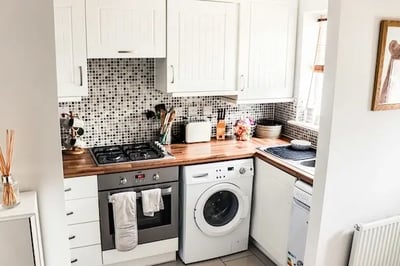
The biggest culture shock is not whether appliances exist but what they look like. According to Russell, "not all properties have those big fridge freezers. Some of them are those tiny fridge freezers." If you are used to a full-size American refrigerator, plan your grocery runs, meal prep, and pet food storage around less space.
Laundry is the next surprise. "Not all properties will have a dryer," he explains. "Some will just be a washing machine." For pet owners, that matters. Dog beds, blankets, and towels after a muddy walk take longer to dry without a tumble dryer, so you may want a drying rack or a property that already has a dryer.
Dishwashers are the third gap. In smaller one-bed flats and studios, he notes, "some of them don't have a dishwasher." If a dishwasher is a must-have, add it to your search filters and confirm it with the agent.
What American expats say on Reddit
Americans who have already made the move say the same thing. In an r/AmericanExpatsUK thread titled "What is a typical U.K. home and what things can we take?", one member advised: "Don't count on having a dryer for your clothes, unless you want to buy one yourself in the rental. Also your rental might not come with a washer, fridge or dishwasher (if there is the space for it)." (r/AmericanExpatsUK discussion)
The takeaway: treat every appliance as unconfirmed until it is listed in writing.
Should You Ship Your American Appliances to the UK, or Use the Landlord's?
Most American families leave their large appliances behind. UK homes use a different mains voltage and a different three-pin plug than U.S. homes, and full-size American appliances may not fit a UK kitchen even if you convert the power. The practical path is to find out what the rental includes first, then buy UK-spec appliances only for the gaps.
There is also a real advantage to using the landlord's appliances. A landlord must make sure "all appliances they supply are safe," and that furniture and furnishings they supply meet fire safety rules (see your landlord's safety responsibilities). Landlords are also usually responsible for repairing gas appliances, heating and hot water, and electrical wiring.
Appliances you buy yourself are yours to repair, replace, and move out when you leave. Before buying anything, check your tenancy agreement to see who is responsible for each item.
How to Get Appliances and Pet Permission in Writing Under the Renters' Rights Act
The single most useful habit for a UK rental is putting everything in writing. As Russell warns, "if you don't put it in writing to begin with, they are less likely to get those things fixed or done for you, so just put everything in writing, including your pet."
The law in England now gives that advice more weight. The Renters' Rights Act changed private renting on 1 May 2026. Under the new rules, "You can ask to keep a pet in the property. Your landlord must consider your request and should give you a reason if they refuse". If you think a refusal is unreasonable, the government's guide says you can escalate to the Private Rented Sector Ombudsman or the courts.
There is one important exception for flats. The same guide says it will always be reasonable for a landlord to refuse a pet when their superior landlord prohibits pets, which can apply in leasehold buildings. Ask about building rules before you fall in love with a flat.
New tenancies starting on or after 1 May 2026 must come with certain written information, usually in a written tenancy agreement. Use that document to record:
- Each appliance included with the property, and its condition at move-in
- Your landlord's consent to your pet, including the species and number of pets
- Who is responsible for repairing or replacing each appliance
These rules apply in England. Scotland, Wales, and Northern Ireland have their own rental laws, so check the rules for the nation you are moving to.
"Families spend months getting the pet import paperwork right, then get caught off guard by the apartment itself. Before you sign a UK lease, get two things in writing: exactly which appliances stay with the property, and your landlord's consent to your pet. Those two lines in a tenancy agreement prevent most of the move-in surprises we hear about." Adam Melton, VP of Strategic Initiatives, Starwood Pet Travel
What to Budget When Setting Up a UK Rental Home with a Pet
Upfront costs for a UK rental in England are capped by law in several places, which makes planning easier. Here is what to set aside, with the official source for each figure.
| Cost | What to expect | Source |
|---|---|---|
| Tenancy deposit | Up to 5 weeks' rent if annual rent is under £50,000; up to 6 weeks' rent at £50,000 or more | Tenant Fees Act 2019, Sch. 1 para 2 |
| Rent in advance | Up to 1 month's rent, payable only after you sign the tenancy agreement | GOV.UK |
| Council Tax | Varies by local council; you usually pay if you are 18 or over | GOV.UK |
| TV Licence | £180 per year if you watch live TV or use BBC iPlayer | GOV.UK |
| Missing white goods | Depends on the gaps: dryer, dishwasher, or a larger fridge freezer | Confirm with your letting agent |
For pet owners, the deposit matters most. The government's guide to the Renters' Rights Act says the tenancy deposit can be used for damage, including damage caused by a pet. Document the property's condition with photos at move-in so normal wear is not mistaken for pet damage when you move out.
Also budget for the pet supplies that do not travel well: a drying rack if there is no dryer, washable throws for carpeted rooms, and storage for pet food if the fridge freezer is small.
Bringing Your Dog or Cat to Great Britain While You House Hunt
Your house hunt and your pet's import paperwork run on the same calendar, so start both early. To bring a pet dog, cat, or ferret into Great Britain you must:
- Check that your travel route is approved for pet travel
- Microchip your pet before the rabies vaccination
- Vaccinate against rabies, then wait at least 21 full days after the first vaccination before travel (some vaccines require a 30-day wait)
- Get the correct pet travel document from your vet
- For dogs, arrange tapeworm treatment no less than 24 hours and no more than 5 days before arrival
The 21-day rabies wait means you can often line up pet travel with your lease start date, but only if the vaccination happens well before you fly. Banned dog breeds cannot enter Great Britain without a valid Certificate of Exemption, so confirm your dog's breed status before you sign anything.
For the full import process, see our complete guide to pet travel from the USA to the UK. If you want help timing your pet's flight around your move-in date, visit our United Kingdom pet transport page.
Frequently Asked Questions
What are white goods in the UK?
+
White goods are large household appliances, such as the fridge freezer, washing machine, tumble dryer, dishwasher, and cooker. It is the British term for what Americans usually call appliances.
Do UK rentals come with a washer and dryer?
+
Many UK rentals include a washing machine, but a separate tumble dryer is less common. Ask the letting agent to confirm each appliance in writing.
Are fridges smaller in the UK?
+
Often, yes. Many UK homes, especially flats, have a smaller fridge freezer than a typical American refrigerator, so plan food and pet food storage accordingly.
Who fixes appliances in a UK rental?
+
If the landlord supplied the appliance, they must make sure it is safe. Check your tenancy agreement for who repairs or replaces each item.
Can a UK landlord refuse my pet?
+
In England, since 1 May 2026, your landlord must consider a written pet request and should give a reason if they refuse. A refusal is always reasonable if a superior landlord prohibits pets.
How much deposit will I pay on a UK rental?
+
In England, a tenancy deposit is capped at five weeks' rent when annual rent is under £50,000, and six weeks' rent at £50,000 or more.
Should I ship my American appliances to the UK?
+
Usually not. UK homes use a different voltage and plug type, and American appliances may not fit UK kitchens. Confirm what the rental includes, then buy UK appliances for any gaps.
Make this guide about your pet.
Every pet's move is a little different. Pick an AI assistant, hit send, and chat through your pet's breed, your route, and your timeline. You'll land with a checklist made for your move.
AI can get details wrong, and pet import rules change often, so double-check before you travel.
FlightDestinationStatus
SW 101
Ask ChatGPT
Boarding
SW 102
Ask Claude
Boarding
SW 103
Ask Perplexity
Boarding
SW 104
Ask Gemini
Boarding
Copies the message to your clipboard, then opens Gemini so you can paste it
See the message we'll send

About the Author
Ashley Adkins, Marketing Specialist
I've been with Starwood since 2018 and have served a variety of different roles. I began as a Pet Travel Coordinator and am now a Marketing Specialist. I've always been an animal lover and grew up riding horses. I've also worked summers at a local vet hospital. I'm born and raised in Connecticut and love travel, spending time with friends and family, making my own greeting cards, and have a minor addiction to coffee.
Talk to our experts
Need help or have questions? Our team is ready to help!

Get a quote →
Subscribe for Monthly Updates
Subscribe for expert pet travel tips, updates, and relocation guides—delivered to your inbox.