Can You Bring a Bengal or Savannah Cat to Singapore?
 By Georgiana Strait, Marketing Manager
Singapore Pet Shipping
Singapore
Singapore Pet Import
Asia
SHORT ANSWER
Yes, but only if your cat is far enough removed from its wild ancestor. Singapore's Animal & Veterinary Service (AVS), part of the National Parks Board, allows Bengal and Savannah cats to be imported as pets only when they are at least five generations (F5 or later) away from the Asian leopard cat or the serval. You must prove it with a pedigree certificate that traces five generations of lineage. Early-generation hybrids (F1 to F4), and any Bengal or Savannah you can't document on paper, can't be imported, even if they meet every vaccination and health requirement.
Video Walkthrough
Can You Bring a Bengal or Savannah Cat to Singapore? (The Pedigree Rule)
EXPLORE THIS ARTICLE
- Why Singapore Restricts Bengal and Savannah Cats
- What "F5" Means for Your Cat's Import Eligibility
- The Pedigree Certificate: The Document That Decides Everything
- Singapore's Standard Cat Import Requirements Still Apply
- Don't Forget U.S. State Rules on the Way Out
- Living With a Bengal or Savannah in Singapore
- How Starwood Checks Hybrid Cat Eligibility Before a Singapore Move
Key Takeaways
- 1. Singapore treats Bengal and Savannah cats as hybrids, so breed papers matter as much as vaccinations. Your cat must be at least F5, meaning five generations removed from a wild cat.
- 2. A pedigree certificate showing five generations of lineage is the document that proves eligibility. A Bengal adopted from a shelter or rehomed by a friend usually has no papers, which can make it ineligible to enter Singapore.
- 3. Early-generation hybrids (F1 to F4) are not allowed in as pets. The five-generation line also mirrors how CITES, the international wildlife trade treaty, treats hybrids with a wild parent in the previous four generations.
- 4. Once breed eligibility is confirmed, your cat still has to meet Singapore's standard import conditions: an ISO microchip, rabies vaccination, an AVS import licence, a quarantine booking where required, and a USDA-endorsed health certificate.
- 5. Confirm your cat's paperwork before you spend money on vet visits or book a flight. A missing pedigree is the one problem no vet appointment can fix.
Why Singapore Restricts Bengal and Savannah Cats
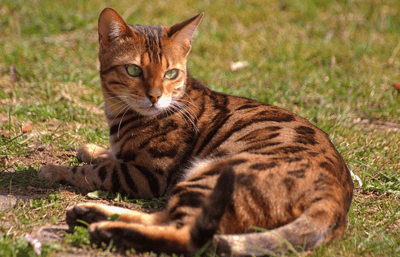
Bengal and Savannah cats are popular, affectionate, and often indistinguishable from a domestic shorthair in everyday life. On paper, though, both breeds carry wild ancestry. Bengals descend from crosses between domestic cats and the Asian leopard cat (Prionailurus bengalensis). Savannahs descend from crosses with the African serval (Leptailurus serval).
Singapore's Animal & Veterinary Service regulates which animals can be imported and kept as pets, and it draws a clear line between domestic cats and wild animals. A hybrid cat sits between those two categories, so AVS uses generation count to decide which side of the line it falls on. The further a cat is from its wild ancestor, the more it is treated as a domestic pet.
This is a separate question from health. A Bengal can be microchipped, vaccinated, titer tested, and parasite free and still be refused if its lineage isn't documented.
What "F5" Means for Your Cat's Import Eligibility
Breeders label hybrid generations with the letter F (for "filial") and a number. An F1 Savannah has a serval parent. An F2 has a serval grandparent. Each step down the line adds one more generation of domestic breeding between your cat and the wild cat.
For Singapore, the cutoff is five generations. Your Bengal or Savannah must be F5 or later to qualify as a pet import. In practice, most Bengals sold by registered breeders today are many generations removed from the Asian leopard cat and are registered as SBT (stud book tradition) cats, which means at least four generations of Bengal-to-Bengal breeding. Savannahs are different. Early generations (F1 to F3) are widely bred and sold in the United States, so Savannah owners need to check generation status carefully.
The five-generation threshold isn't arbitrary. Under CITES Resolution Conf. 10.17, hybrids with a CITES-listed wild animal in their previous four generations are regulated as if they were that wild species. Both the Asian leopard cat and the serval appear in the CITES Appendices. A cat at F5 or later has cleared that four-generation window.
The Pedigree Certificate: The Document That Decides Everything
The document that proves your cat's generation is a pedigree certificate showing five generations of lineage. This is the detail that catches families off guard, and it came up directly on a recent episode of Starwood's Pet Travel Insider podcast. If you picked up a Bengal from a friend of the family, or adopted a Bengal mix from a shelter, there's a good chance you have no pedigree at all.
Without that pedigree, there is no way to show AVS that your cat is F5 or later. Appearance doesn't help here. A rosetted coat or a long, lean build can suggest Bengal or Savannah ancestry, but it can't prove generation.
If your cat came from a registered breeder, contact the breeder or the registry that issued your cat's papers. Request a certified pedigree that lists at least five generations of ancestors. If your cat has no breeder records, talk to a pet relocation specialist before you start any import steps, because a shelter Bengal with no papers may simply not be eligible.
Singapore's Standard Cat Import Requirements Still Apply
Passing the hybrid test only gets your cat to the starting line. Every cat entering Singapore must also meet AVS import conditions, which depend on the country your cat is exported from. For cats leaving the United States, plan for these core steps:
- ISO microchip. Implanted before the rabies vaccination, with the same number on every document.
- Rabies vaccination and any required blood testing. Timing rules depend on the export country's risk category, so confirm them on the AVS import page.
- AVS import licence. Each cat needs its own licence, applied for before travel.
- Quarantine booking, where required. Cats from some countries must complete quarantine at Singapore's Animal Quarantine Station, and space must be reserved in advance.
- Veterinary health certificate. Completed by a USDA-accredited veterinarian and endorsed by USDA APHIS.
- Arrival as manifested cargo. Pets arrive at Changi Airport through the Animal Reception Centre rather than in the cabin.
For a full walkthrough of each step and the paperwork involved, see Starwood's Importing Pets to Singapore guide.
Don't Forget U.S. State Rules on the Way Out
Singapore's rules govern entry, but your cat also has to leave the United States legally. Some states and cities regulate early-generation Savannahs and Bengals, and a few prohibit them. If your cat is a later generation and you have papers, this is rarely an issue. If you're unsure of your cat's generation, check your state wildlife or agriculture department before booking anything.
Living With a Bengal or Savannah in Singapore
Once your cat arrives, Singapore's cat ownership rules apply. AVS introduced a cat management framework that permits cats in HDB flats and requires pet cats to be microchipped and licensed, with limits on how many cats a household can keep. If you're renting, check your lease and your building's rules before you arrive, since private landlords can set their own pet policies.
How Starwood Checks Hybrid Cat Eligibility Before a Singapore Move
The safest order of operations is papers first, vet work second. Before any vaccinations or blood draws, gather your cat's registration papers and pedigree and confirm the generation count. If the pedigree shows fewer than five generations, or doesn't exist, you'll know before you've spent anything on travel prep.
As Ryan Bole, Director of Pet Travel Coordinators at Starwood Pet Travel, explains: "We get calls from families who have done everything right on the health side and only find out about the pedigree rule at the end. A Bengal from a breeder usually has the papers. A Bengal from a neighbor or a shelter usually doesn't. That's why the first thing we ask about a Bengal or Savannah headed to Singapore isn't the rabies certificate. It's the family tree."
If you want help confirming your cat's eligibility and building a full Singapore timeline, request a free quote and our team will review your cat's documents with you.
Frequently Asked Questions
Can I bring an F1 or F2 Savannah cat to Singapore?
+
No. Singapore only allows hybrid cats that are at least five generations removed from their wild ancestor. F1 through F4 Savannahs don't qualify as pet imports.
My Bengal came from a shelter and has no papers. Can it still travel to Singapore?
+
Without a pedigree showing five generations of lineage, there's no way to prove your cat meets the F5 requirement. Speak with AVS or a pet relocation specialist before starting any import steps.
Does a DNA test prove my Bengal is F5 or later?
+
A breed DNA test can suggest Bengal ancestry, but it doesn't establish how many generations separate your cat from the Asian leopard cat. The document AVS looks for is a pedigree certificate showing five generations.
Do Bengal and Savannah cats need extra vaccinations for Singapore?
+
No. Once eligibility is confirmed, they follow the same AVS import conditions as any other pet cat, including microchipping, rabies vaccination, an import licence, and an endorsed health certificate.
Is an SBT Bengal automatically eligible?
+
SBT means at least four generations of Bengal-to-Bengal breeding, and most SBT cats are well past F5. Your pedigree still needs to show five generations, so request a full certified pedigree from your breeder or registry.
Can I keep my Bengal in an HDB flat?
+
Cats are permitted in HDB flats under Singapore's cat management framework, which requires licensing and microchipping and caps the number of cats per household. Check AVS's current licensing rules once your cat has cleared import.
Make this guide about your pet.
Every pet's move is a little different. Pick an AI assistant, hit send, and chat through your pet's breed, your route, and your timeline. You'll land with a checklist made for your move.
AI can get details wrong, and pet import rules change often, so double-check before you travel.
FlightDestinationStatus
SW 101
Ask ChatGPT
Boarding
SW 102
Ask Claude
Boarding
SW 103
Ask Perplexity
Boarding
SW 104
Ask Gemini
Boarding
Copies the message to your clipboard, then opens Gemini so you can paste it
See the message we'll send

About the Author
Georgiana Strait, Marketing Manager
Georgiana Strait is a marketing manager at Starwood Pet Travel, where she leads content strategy, SEO, paid media, and marketing automation across the company's international pet relocation services. A performance-driven digital marketing strategist with a background in customer acquisition and data analytics, Georgiana brings a sharp, iterative approach to building out Starwood's marketing infrastructure, from AI search visibility to lifecycle campaigns. She's also a U.S. Army veteran. Outside of work, Georgie is an avid traveler who has hiked to Everest Base Camp. She lives with her cat, Lavender.
Talk to our experts
Need help or have questions? Our team is ready to help!

Get a quote →
Subscribe for Monthly Updates
Subscribe for expert pet travel tips, updates, and relocation guides—delivered to your inbox.